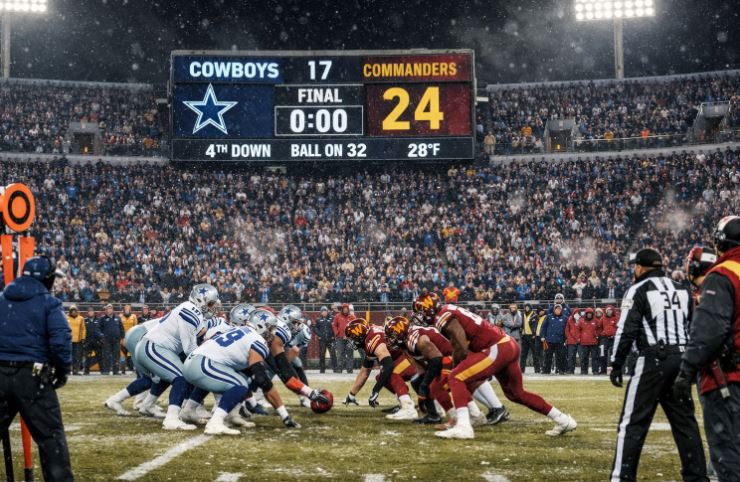
The Washington Commanders vs Dallas Cowboys match player stats from the Christmas Day 2025 NFL clash tell a detailed story of control, discipline, and timely execution. Played at Northwest Stadium in Landover, Maryland, this matchup brought together two teams at different stages of their season journeys.
Dallas entered the game with a 7 8 1 overall record and a 3 5 away record, while Washington came in at 4 12 with struggles at home reflected in a 2 6 record.
From the opening drive, the contest showed signs of being shaped by possession, efficiency, and individual brilliance rather than turnovers or chaotic moments. The Cowboys eventually secured a 30 23 victory, but the scoreline only partially explains how the game unfolded.
A closer look at the quarter by quarter progression, individual performances, and team statistics highlights why Dallas controlled the tempo and how Washington showed flashes of promise despite the loss.
This detailed breakdown focuses on how the game developed, who stood out, and what the numbers reveal when analysed carefully. Every insight is drawn from the official box score, match reports, and leading sports coverage from trusted sources, ensuring accuracy and relevance for the 2025 NFL season.
How Did the Game Unfold Quarter by Quarter?
The flow of the game clearly reflected Dallas’ ability to sustain drives and manage the clock, while Washington relied more on explosive moments rather than extended possessions. Each quarter contributed to the overall narrative of control versus efficiency.
First Quarter Momentum
Dallas set the tone early with a touchdown drive that lasted 13 plays and covered 78 yards in just over five minutes. This opening possession immediately showed the Cowboys’ intention to dominate time of possession.
Washington responded positively with an eight play field goal drive, trimming the score to 7 3, but the early balance already leaned towards Dallas.
Second Quarter Control
The second quarter proved decisive. Dallas opened with another methodical touchdown drive of 17 plays, followed by a rapid scoring drive covering 97 yards in just over two minutes.
Washington briefly responded with a touchdown drive of their own, but Dallas closed the half with a field goal, taking a 24 10 lead into the break. The Cowboys’ ability to mix long drives with quick strikes created separation on the scoreboard.
Second Half Response
Washington commanders showed resilience after halftime. A 72 yard touchdown play early in the third quarter reignited the home crowd, followed by a sustained field goal drive that narrowed the gap to 27 20. However, Dallas consistently answered with points, ensuring the Commanders never fully seized momentum.
Final Quarter Execution
The fourth quarter highlighted Dallas’ composure. Despite a missed field goal, the Cowboys burned significant clock on a 14 play drive before extending their lead to 30 20.
Washington added a late field goal, but Dallas closed the game with a controlled final possession to seal the 30 23 result.
Who Were the Offensive Standouts in the Match?
Individual performances shaped the Washington Commanders vs Dallas Cowboys match player stats narrative, particularly on offense where Dallas showcased balance and Washington relied on select playmakers.
Dallas Cowboys Offensive Leaders
Dak Prescott delivered a composed performance, throwing for 307 yards on 19 completions from 37 attempts and registering two passing touchdowns. His decision making stood out, especially with zero interceptions against a defensive front that applied pressure.
The Cowboys’ ground game was led by Malik Davis, who recorded 103 rushing yards on 20 carries. His consistency allowed Dallas to control tempo and keep Washington’s defence on the field. KaVontae Turpin added a spark with 86 receiving yards and a touchdown from a single catch, highlighting Dallas’ ability to generate explosive plays.
Washington Commanders Key Contributors
Josh Johnson provided stability at quarterback, completing 15 of 23 passes for 198 yards without turnovers. While he did not throw a touchdown, his efficiency kept Washington competitive.
Jacory Croskey Merritt emerged as a standout with 105 rushing yards on 11 carries and two rushing touchdowns, accounting for the Commanders’ most impactful scoring plays.
Deebo Samuel contributed in the receiving game with 68 yards on two receptions, showing his big play potential even with limited targets.
What Do the Defensive Stats Reveal About the Matchup?
Defensive numbers from this game underline the importance of pressure and tackling efficiency rather than takeaways, as neither team committed a turnover.
Dallas Defensive Impact
Dallas generated six sacks for a total loss of 38 yards, consistently disrupting Washington’s offensive rhythm. Jadeveon Clowney led the pass rush with 1.5 sacks, applying pressure at crucial moments.
Linebacker Shemar James contributed six total tackles, three of which were solo efforts, helping limit Washington on third down situations.
Washington Defensive Highlights
Washington’s defensive front found success through JerZhan Newton, who recorded three sacks and was a constant presence in the interior.
Bobby Wagner anchored the defence with ten total tackles, five solo, showcasing leadership and experience in containing Dallas’ short passing game.
Despite these efforts, extended drives by Dallas wore down the Commanders’ defence over time, particularly late in each half.
How Did the Team Stats Compare Overall?
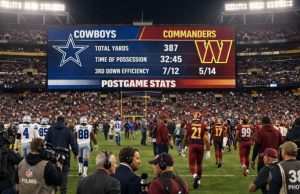
Team statistics provide a clear explanation for the final score and illustrate how Dallas maintained control throughout the contest.
Team Comparison
| Category | Dallas Cowboys | Washington Commanders |
| Total Yards | 480 | 328 |
| First Downs | 28 | 17 |
| Time of Possession | 38:44 | 21:16 |
| Third Down Efficiency | 8 of 20 | 1 of 6 |
| Fourth Down Efficiency | 6 of 6 | 0 of 0 |
| Penalties | 11 for 89 yards | 10 for 71 yards |
| Turnovers | 0 | 0 |
Dallas ran 87 total plays compared to Washington’s 41, highlighting a significant disparity in offensive opportunity. The Cowboys’ dominance on fourth down conversions further extended drives and exhausted the Commanders’ defence.
Who Dominated the Air and Ground Game?
The balance between passing and rushing was a defining factor in the Washington Commanders vs Dallas Cowboys match player stats.
Passing Game Comparison
Dallas accumulated 269 passing yards with an average of 6.3 yards per pass attempt. Washington recorded 190 passing yards with a higher average of 7.6 yards per attempt, showing efficiency but fewer total opportunities.
Rushing Game Comparison
On the ground, Dallas posted 211 rushing yards from 44 attempts, averaging 4.8 yards per carry. Washington produced 138 rushing yards on just 16 attempts, averaging an impressive 8.6 yards per carry but lacking volume.
This contrast highlights how Washington relied on explosive rushing plays, while Dallas leaned on sustained production.
What Impact Did Special Teams and Coaching Decisions Have?
Special teams and coaching choices subtly influenced the outcome without overshadowing offensive execution.
Key Special Teams Moments
Dallas missed a field goal in the fourth quarter, briefly giving Washington hope. However, the Cowboys’ ability to rebound with a long scoring drive reflected strong sideline management. Washington converted all of their field goal attempts, keeping the scoreline respectable.
Coaching Influence
Dallas’ coaching staff displayed confidence with six successful fourth down conversions. These decisions extended drives and demonstrated trust in the offensive unit.
Washington, on the other hand, had limited opportunities to attempt fourth down conversions due to fewer sustained drives.
What Do These Results Mean for Both Teams Going Forward?
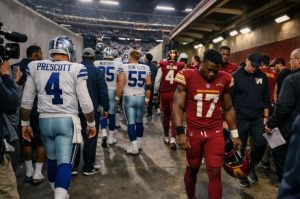
This result reinforced Dallas’ ability to control games late in the season, even with a mixed overall record. The Cowboys demonstrated that disciplined football, balanced play calling, and defensive pressure can compensate for inconsistency earlier in the campaign.
For Washington, the loss added to a challenging season, but individual performances from younger players like Croskey Merritt and strong defensive contributions from veterans provided positives to build upon. The Commanders’ efficiency per play suggests potential if offensive volume and consistency improve.
Washington Commanders vs Dallas Cowboys Match Player Stats
This section brings together the most important individual numbers that defined the contest and influenced its outcome.
Key Player Statistics
| Player | Team | Stat Line |
| Dak Prescott | Dallas | 307 passing yards, 2 TD |
| Josh Johnson | Washington | 198 passing yards |
| Malik Davis | Dallas | 103 rushing yards |
| Jacory Croskey Merritt | Washington | 105 rushing yards, 2 TD |
| KaVontae Turpin | Dallas | 86 receiving yards, 1 TD |
| Deebo Samuel | Washington | 68 receiving yards |
| JerZhan Newton | Washington | 3 sacks |
| Jadeveon Clowney | Dallas | 1.5 sacks |
These figures underline the balance of Dallas’ attack and Washington’s reliance on standout individual efforts rather than sustained team production.
What Were the Key Moments That Defined the Game?
Several moments shaped the narrative beyond the final score. Dallas’ opening drive established immediate control and set the tempo. The 97 yard touchdown drive in the second quarter was a psychological blow that stretched the lead.
Washington’s 72 yard touchdown early in the third quarter briefly shifted momentum, but Dallas’ response through field goals and clock management prevented a full comeback.
The final drive by Dallas, lasting over two minutes, symbolised their control and ensured the game ended on their terms.
Conclusion
The Washington Commanders vs Dallas Cowboys match player stats reveal a contest defined by efficiency, balance, and discipline. Dallas’ 30 23 victory was built on sustained drives, superior time of possession, and consistent execution across all phases.
Washington showed flashes of brilliance, particularly in the running game and defensive front, but struggled to match Dallas’ volume and control.
For fans and analysts, this Christmas Day matchup offered a clear example of how detailed statistics often tell a richer story than the scoreboard alone.
As both teams move forward, the lessons from this game will influence tactical adjustments and player evaluations in the seasons ahead.
FAQs
How did Dak Prescott influence the game outcome?
Dak Prescott influenced the game by managing long drives, throwing for over 300 yards, and avoiding turnovers, which allowed Dallas to control possession.
Why was time of possession important in this match?
Time of possession mattered because Dallas held the ball for over 38 minutes, limiting Washington’s offensive opportunities.
Which Washington player had the biggest impact?
Jacory Croskey Merritt had the biggest impact for Washington with over 100 rushing yards and two touchdowns.
Did turnovers play a role in the final result?
Turnovers did not play a role as both teams finished the game without committing any.
How effective was the Dallas running game?
The Dallas running game was effective due to consistent yardage and volume, helping maintain offensive balance.
What stood out defensively for Washington?
JerZhan Newton’s three sacks stood out as a key defensive highlight for Washington.
How did coaching decisions affect the match?
Dallas’ aggressive fourth down decisions extended drives and kept momentum on their side throughout the game.